Cardiff Theosophical Society in Wales, UK
DEFINED
From the writings of William Quan Judge, a pioneering
Theosophist and
co-founder of the orginal Theosophical Society, founded in
theosophycardiff@uwclub.net
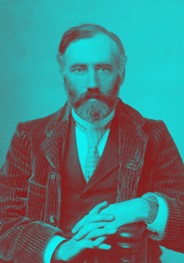
William
Quan Judge
1851
- 1896
Theosophy Defined
By
William Quan Judge
Theosophy
[from Gr. theosophia knowledge of divine things, deriv. of theosophos wise
about God; theos God + sophos, wise]: a name which, as specifying a religious philosophy,
was originated by Ammonius Saccas in the third century of our era.
The body of
ethical, philosophic, and scientific doctrines to which that title applies is,
however, as old as humanity itself, and contains everything that is true in all
other and later systems. Esoterically preserved and transmitted in its entirety
by adepts and initiates, from time immemorial, their messengers -- known to the
world as "great teachers" and "saviours" -- have, at
periodic intervals determined by cyclic law, exoterically taught as much of it
as could safely be given out and which any considerable portion of our race
could at such times receive and assimilate.
Theosophy
teaches a knowledge of the laws governing the evolution of the universe. It is
not based upon assumed divine revelation, but upon consciousness. It sees no
unsolvable mystery anywhere, throws the words coincidence and chance out of its
vocabulary, and affirms the omnipresence and omnipotence of law and perfect
justice.
Theosophy
postulates an Eternal Principle, unknowable except in its manifestations, which
is in and is all things, and which, periodically and eternally, manifests
itself and recedes from manifestation -- evolution and involution. Its opposite
poles in the manifested universe are spirit and matter, which are coexistent
and inseparable.
In
manifesting itself the spirit-matter differentiates on seven planes, which are
of progressive density down to that within our sensuous perception, the
substance in all being the same, but differing in the proportions of its two
compound elements. Through all thrill ceaselessly vibrations which are the
inexhaustible impulse from the First Cause. These vibrations are distinct, each
from all the others, and each always the same in mode upon every plane, but
differing in rate according to the rarity or density of the substance of the
plane. By means of these vibrations are brought about all forces -- phenomena
in nature, specialized differentiations and effects of creation, preservation,
and mutation -- in the world of forms as well as upon the ethereal planes.
Thus every
atom of the universe is infused with spirit, which is life in one of its phases
of manifestation, and endowed with qualities of consciousness and intelligence
-- likewise phases of the spirit -- in conformity to the requirements of its
differentiation.
On the lowest
material plane, which is that of humanity, the spirit focalizes itself in all
human beings who permit it to do so. Its rejection is the cause of ignorance,
from which flow all sin, suffering, and sorrow; by its conscious acceptance man
becomes partaker of the Divine Wisdom, "one with the gods," entering
into possession of an ever-increasing power of consciousness, and attains
oneness with the Absolute. This is the ultimate destiny of all beings; hence
Theosophy affirms the perfectibility of the race and rejects the concept of
innate unregenerable wickedness.
From the
theosophic point of view the world is compounded of the Egos or individual
spirits, for whom it emanates from the Divine Will; and its evolution is due to
the impulse imparted by its spiritual element, that force manifesting itself
from the beginning in the primary conditions of life -- far below the sentient
stage -- and having in the evolvement of higher forms, including man, the
guidance and direction of intelligent, perfected beings from other and older
evolutions. Hence man is deemed a conscious spirit, the flower of evolution;
while below him, in the lower kingdoms, are other less-advanced classes of egos,
all, however, on the way of ascent to the human stage, which they will
eventually reach when man has gone on still higher.
The
perfecting of self-consciousness is the object of evolution. By this man is
enabled to reach more exalted stages of existence. And his conditioned mortal
life is for the purpose of affording him experience by which that
self-consciousness may be developed and cognition of the spirit attained.
Man is a
spirit and requires vehicles with which to come in touch with all the planes of
nature included in evolution, and it is these vehicles that make of him an
intricate, composite being, liable to error, but at the same time able to rise
above all delusions. He is in miniature the universe, for he is, as spirit,
manifesting himself to himself by means of seven differentiations. Therefore he
is characterized in Theosophy as a septenate or sevenfold being. His immortal
being comprises a trinity, spirit (Atman), the spiritual soul or discernment
(Buddhi), and mind (Manas).
This triad requires
as vehicles or instruments through which to operate and gain cognition in
matter four lower mortal principles.
These are:
The animal passions and desires, unintelligent and productive of ignorance
through delusion (
The Linga
Sarira belongs to the astral plane of matter, which, being next above that of
our tangible world in refinement of its substance, is just beyond our normal
sensuous perception. As the physical body is at death reabsorbed into the
material elements whence it was drawn, so the astral body is eventually
dissipated in and absorbed by the substance of its plane; but its permanence is
much greater than that of the gross body. During life it is from the earliest
moment until the last the model upon which are molded the physical molecules of
which the body is composed, and through it the life-principle is enabled to
animate the aggregate mass as a collective entity. These lower four principles
or sheaths are the transitory, perishable part of man -- not himself, but in
every sense the instruments he uses -- given up at the hour of death and
rebuilt at every new birth. The trinity is the real man, the thinker, the
individuality that passes from house to house, gaining experience at each
rebirth, while it suffers and enjoys according to its deeds. In each successive
earth-life he is known to others as a new personality, but in the whole stretch
of eternity he is one individual, conscious of an identity not dependent on
name, form, or recollections of personalities. This doctrine of reincarnation
is the very base of Theosophy, for it explains life and nature as no other
hypothesis can; and it is an essential to the scheme of evolution, for without
such re-embodiment on the plane of experiences and atonements there could be no
evolution of the human soul.
The Ego
returning to mortal life only goes into the family which either completely
answers to its whole nature, gives an opportunity for its evolutionary
progress, or is connected with it by reason of events in past incarnations and
causes mutually created. Inseparable from the doctrine of reincarnation is that
of Karma, or justice, sometimes called the "ethical law of
causation." Mere entry into life is no fit foundation for just reward or
punishment, which must be the deserts for prior conduct. But such consequent
awards determine entry into life, and with unerring equity establish the sequence
of good and evil happenings in requital of the past.
Effect is
always in cause, and thus the body, brain, and intellectual faculties furnished
by reincarnation being products of one's own deserving, become the field from which
must be gleaned the harvest planted by acts in the past. The law of Karma
applies in physical nature as well as in ethics to solar systems, planets,
races, nations, families, and individuals. With reincarnation the doctrine of
Karma explains the misery and suffering of the world, and no room is left to
accuse nature of injustice. The misery of any nation or race is the direct
result of the thoughts and acts of the Egos who make up the race or nation. If
they did wickedly in the past, they must suffer the inevitable consequences. To
this end they must go on incarnating and reincarnating until the effects they
caused have been exhausted. Though the nation thus suffering chastisement
should for a time disappear, the Egos belonging to it could not leave the
world, but would reappear as the founders of some new nation in which they
would continue to receive their karmic due.
With
reference to postmortem conditions, Theosophy teaches two states of existence
somewhat analogous to the Christian "purgatory" and
"heaven." The first, immediately subsequent to earth-life, is
Kama-loka, where the immortal triad takes leave of the lower principles
remaining after separation from the body. Thence the Ego passes into Devachan.
The former is, as its name indicates, a place -- the astral plane penetrating
and surrounding the earth -- the latter a state of being, or rather of
consciousness.
In Kama-loka
all the hidden passions and desires are let loose, and enough mentality is
retained to make them tortures. When the astral body in which they cohere is
disintegrated, as it is in time, they remain a sort of entity in the Kama-Rupa,
a form of still less materiality than the Linga Sarira. Eventually this too is
said to fade out, leaving only their essence, the Skandhas, fateful germs of
karmic consequence, which, when the Ego emerges from the devachanic state, are
by the law of attraction drawn to the new being in which it incarnates.
Owing to the
law of cohesion between the principles, which prevents their separation before
a given time, the untimely dead must pass in Kama-loka a period almost equal to
the length life would have been but for the sudden termination. Losing the body
has not killed them. They still consciously exist in the astral body, and in
the case of very wicked and forceful persons -- some executed criminals, for
instance -- may be even more harmful on the astral plane than they were in
life.
Prolonged
kama-lokic existence is no injustice to the victims of accident, since death,
like everything else, is a karmic consequence. Finally, it may be said of
Kama-loka that it is the last conscious state of the thoroughly evil human
souls bereft of the spiritual tie and doomed to annihilation (Avichi).
Having in
life centered the consciousness in the kamic principle, preserved intellect and
rejected the spirit, leading persistent lives of evil for its own sake, they
are the only damned beings we know. Pure souls speedily pass from Kama-loka to
the devachanic state. It is a period of rest; a real existence, no more
illusionary than earth life, where the essence of the thoughts of life that
were as high as character permitted expands and is garnered by the soul and
mind. When the force of these thoughts is fully exhausted the soul is once more
drawn back to earth, to that environment which will best promote its further
evolution.
No new ethics
are presented by Theosophy, as it is held that right ethics are forever the
same. But in the doctrines of Theosophy are to be found the philosophical and
reasonable basis of ethics and the natural enforcement of them in practice.
The present
worldwide interest in Theosophy dates from 1875, when Helena P. Blavatsky, a
messenger of the adepts, appeared in New York, initiated the theosophic
movement, and, with Henry S. Olcott, William Q. Judge, and several other
persons, formed the Theosophical Society. Other revivals of the ancient
doctrine, occurring in the last quarter of each century during several hundred
years past, are matters of historic record; but, as their times were not
propitious, they amounted to little in their effect upon humanity at large
compared with the importance this one has attained.
The
Theosophical Society, though its members generally, no doubt, subscribe to
theosophic doctrine, is not dogmatic, but admits to membership all who can
conscientiously accept its three avowed objects:
1. "To
form the nucleus of a Universal Brotherhood of Humanity without any
distinctions whatever.
2. To promote
the study of ancient and modern religions, philosophies, and sciences.
3. To
investigate unexplained laws of nature and the psychical powers of man."
Starting with
a membership of fifteen persons in 1875, it has spread all over the globe,
until now it has hundreds of branches scattered through all the civilized and
even the semi-civilized countries, and counts its members by thousands. Beyond
its organization in importance, however, is the wonderful influence of
theosophic teachings in coloring the literature, thought, ethics, and even
scientific progress and religious expression of the world. The size of the
Society gives but a very imperfect idea of the extent of its work.
The best
books conveying instruction in detail concerning theosophic doctrine -- but a
meager skeleton of which has been offered in the foregoing -- are the
following: H. P. Blavatsky, The Secret Doctrine (1888); Isis Unveiled (1877);
The Key to Theosophy (1889); William Q. Judge, The Ocean of Theosophy (1893);
A. P. Sinnett, Esoteric Buddhism (1883); Five Years of Theosophy, selections from
The Theosophist (1885); Rama Prasad, Nature's Finer Forces (1890); Patanjali
(Judge's version) Yoga Aphorisms (1889). A score of theosophic magazines are
issued in half as many languages. The leading one of the Theosophical Society
in
Is Theosophy a Religion ? By H P Blavatsky
A Textbook of Theosophy By C W Leadbeater
Outline of Theosophy By C W Leadbeater
Theosophy and the Theosophical Society
Events Information Line 029
2049 6017
_______________________
Find out more about
Theosophy with these links

Cardiff Theosophical Society meetings
are informal
and there’s always a cup of tea
afterwards
The Cardiff
Theosophical Society Website
The
National Wales Theosophy Website
Dave’s
Streetwise Theosophy Boards
If you
run a Theosophy Group then please
Feel
free to use any material on this Website
Theosophy Cardiff’s Instant Guide to Theosophy
Cardiff
Theosophical Order of Service (TOS)
Within the
British Isles, The Adyar Theosophical Society has Groups in;
Bangor*Basingstoke*Billericay*Birmingham*Blackburn*Bolton*Bournemouth
Bradford*Bristol*Camberley*Cardiff*Chester*Conwy*Coventry*Dundee*Edinburgh
Folkstone*Glasgow*Grimsby*Inverness*Isle
of Man*Lancaster*Leeds*Leicester
Letchworth*London*Manchester*Merseyside*Middlesborough*Newcastle
upon Tyne
North
Devon*Northampton*Northern Ireland*Norwich*Nottingham
Perth*Republic of Ireland*Sidmouth*Southport*Sussex*Swansea*Torbay
Tunbridge
Wells*Wallasey*Warrington*Wembley*Winchester*Worthing
One Liners & Quick Explanations
The main criteria
for the inclusion of
links on this
site is that they are have some
relationship
(however tenuous) to Theosophy
and are
lightweight, amusing or entertaining.
Topics include
Quantum Theory and Socks,
Dick Dastardly
and Legendary Blues Singers.
No
Aardvarks were harmed in the
Includes
stuff about Marlon Brando, Old cars,
Odeon
Cinema Burnley, Heavy Metal, Wales,
Cups of
Tea, Mrs Trellis of North Wales.
Cardiff
Theosophical Order of Service
General pages about Wales, Welsh History
and The History of Theosophy in Wales
Her Teachers Morya &
Koot Hoomi
The Most Basic Theosophy Website in the Universe
If you run
a Theosophy Group you can use
this as an
introductory handout
Lentil burgers, a
thousand press ups before breakfast and
the daily 25 mile
run may put it off for a while but death
seems to get most
of us in the end. We are pleased to
present for your
consideration, a definitive work on the
subject by a
Student of Katherine Tingley entitled
For everyone everywhere, not just in Wales
Theosophy and the Number Seven
A selection of articles
relating to the esoteric
significance of the Number
7 in Theosophy
The Spiritual Home of Urban Theosophy
The Earth Base for Evolutionary Theosophy
Quick Explanations with Links to More Detailed Info
What is Theosophy ? Theosophy Defined (More Detail)
Three Fundamental Propositions Key Concepts of Theosophy
Cosmogenesis Anthropogenesis Root Races
Ascended Masters After Death States
The Seven Principles of Man Karma
Reincarnation Helena Petrovna Blavatsky
Colonel Henry Steel Olcott William Quan Judge
The Start of the Theosophical
Society
History of the Theosophical
Society
Theosophical Society Presidents
History of the Theosophical
Society in Wales
The Three Objectives of the
Theosophical Society
Explanation of the Theosophical
Society Emblem
The Theosophical Order of
Service (TOS)
Glossaries of Theosophical Terms
by
Annie Besant
THE PHYSICAL
PLANE THE ASTRAL PLANE
KÂMALOKA THE MENTAL PLANE DEVACHAN
THE BUDDHIC AND NIRVANIC PLANES
THE THREE KINDS OF KARMA COLLECTIVE KARMA
THE LAW OF
SACRIFICE MAN'S ASCENT
______________________
Annie Besant Visits Cardiff 1924
An Outline of Theosophy
Charles Webster Leadbeater
Theosophy - What it is How is it Known?
The Method of Observation General Principles
Advantage Gained from this
Knowledge
The Deity The Divine Scheme The Constitution of Man
The True Man Reincarnation The Wider Outlook
Death Man’s Past and Future Cause and Effect
Reincarnation
This guide has been included in response
to the number of enquiries we receive on
this
subject at Cardiff Theosophical Society
From A Textbook
of Theosophy By C W Leadbeater
How We Remember our Past Lives
Life after Death & Reincarnation
The Slaughter of the
a great demand by the public for
lectures on Reincarnation
Classic Introductory Theosophy Text
A Text Book of Theosophy By C
What Theosophy Is From the Absolute to Man
The Formation of a Solar System The Evolution of Life
The Constitution of Man After Death
Reincarnation
The Purpose of Life The Planetary Chains
The Result of Theosophical Study
The Occult World
By
Alfred Percy Sinnett
The
Occult World is an treatise on the
Occult
and Occult Phenomena, presented
in readable style, by an early giant of
the
Theosophical Movement.
Preface to the American Edition Introduction
Occultism and its Adepts The Theosophical Society
First Occult Experiences Teachings of Occult Philosophy
Later Occult Phenomena Appendix
The
Seven Principles of Man
By
Annie
Besant
A Student of Katherine Tingley
Katherine Tingley (1847 -1929)Was the founder &
President
of the Point Loma Theosophical Society 1896 -1929
She and her students produced a series of informative
Theosophical works in the early years of the 20th century
Elementary Theosophy Who is the Man?
Body and Soul
Body, Soul and Spirit Reincarnation
Karma The Seven in Man and Nature
Helena Petrovna Blavatsky 1831 – 1891
The Founder of Modern Theosophy
Index of Articles by
By
H P Blavatsky
Is the Desire to Live Selfish?
Ancient Magic in Modern Science
Precepts Compiled by H P Blavatsky
Obras Por H P Blavatsky
En Espanol
Articles about the Life of H P Blavatsky
Writings of Ernest Egerton Wood
Theosophy and the Number Seven
A selection of articles
relating to the esoteric
significance of the Number
7 in Theosophy
Index of Searchable
Full Text Versions of
Definitive
Theosophical Works
H P Blavatsky’s Secret Doctrine
Isis Unveiled by H P Blavatsky
H P Blavatsky’s Esoteric Glossary
Mahatma Letters to A P Sinnett 1 - 25
A Modern Revival of Ancient Wisdom
(Selection of Articles by H P Blavatsky)
The Secret Doctrine – Volume 3
A compilation of H P Blavatsky’s
writings published after her death
Esoteric Christianity or the Lesser Mysteries
The Early Teachings of The
Masters
A Collection of Fugitive Fragments
Fundamentals of the Esoteric
Philosophy
Mystical,
Philosophical, Theosophical, Historical
and Scientific
Essays Selected from "The Theosophist"
Edited by George Robert Stow Mead
From Talks on the Path of Occultism - Vol. II
In the Twilight”
Series of Articles
The In the Twilight”
series appeared during
1898 in The
Theosophical Review and
from 1909-1913
in The Theosophist.
compiled from
information supplied by
her relatives
and friends and edited by A P Sinnett
Letters and
Talks on Theosophy and the Theosophical Life
Obras Teosoficas En Espanol
Theosophische Schriften Auf Deutsch
Karma Fundamental Principles Laws: Natural and Man-Made
The Law of Laws
The Eternal Now
Succession
Causation
The Laws of Nature A Lesson of The Law Karma Does Not Crush
Apply This Law
Man in The Three Worlds Understand The Truth
Man and His Surroundings The Three Fates
The Pair of Triplets
Thought, The Builder Practical Meditation Will and Desire
The Mastery of Desire Two Other Points The Third Thread
Perfect Justice
Our Environment
Our Kith and Kin Our Nation
The Light for a Good Man Knowledge of Law The Opposing Schools
The More Modern View Self-Examination Out of the Past
Old Friendships
We Grow By Giving Collective Karma Family Karma
National Karma India’s Karma National Disasters
Annotated Edition
Published 1885
Preface to the Annotated Edition Preface to the Original Edition
Esoteric Teachers The Constitution of Man The Planetary Chain
The World Periods Devachan Kama
Loca
The Human Tide-Wave The Progress of Humanity
Buddha Nirvana The
Universe The Doctrine Reviewed
Try these if you are looking
for a
local Theosophy Group or Centre
UK Listing of Theosophical Groups
Worldwide Directory of Theosophical Links

General pages
about Wales, Welsh History
and The History
of Theosophy in Wales
Wales is a
Principality within the United Kingdom
and has an eastern
border with England. The land
area is just over
8,000 square miles. Snowdon in
North Wales is the
highest mountain at 3,650 feet.
The coastline is
almost 750 miles long. The population
of Wales as at the
2001 census is 2,946,200.
__________________________________________
into categories and presented according to relevance of
website.
Hey Look! Theosophy in Cardiff